Tired, Cold, Gaining Weight? It Might Be Your Thyroid
Is It Your Thyroid? A Clear Guide to Thyroid Health and Metabolism

You’re tired no matter how much you sleep. The scale is creeping up even though nothing has changed. You’re cold when everyone else is comfortable. It’s reasonable to wonder: is it my thyroid?
Sometimes it is. Thyroid conditions are common. About 20 million Americans have some form of thyroid disease, and an estimated one in eight women will develop a thyroid disorder in her lifetime. But fatigue and weight gain have many causes, and guessing doesn’t help anyone.
This guide covers what your thyroid does, the signs worth paying attention to, what it really has to do with your weight, and how to get a clear answer.
What your thyroid actually does
Your thyroid is a small, butterfly-shaped gland at the front of your neck. It makes hormones, mainly T4 and T3, that set the pace for nearly every cell in your body.
Think of thyroid hormone as your body’s thermostat and accelerator. It influences how quickly you burn energy, your heart rate, body temperature, digestion, mood, and even your skin and hair.
Your brain keeps it in balance. The pituitary gland releases TSH (thyroid-stimulating hormone) to tell the thyroid to make more. When thyroid hormone runs low, TSH rises. When it runs high, TSH falls. That feedback loop is why TSH is usually the first lab your clinician checks.
Signs your thyroid may be off
Thyroid problems usually fall into two camps. Hypothyroidism means the gland is underactive and everything slows down. Hyperthyroidism means it’s overactive and everything speeds up. Hypothyroidism is far more common: about 5 in 100 Americans age 12 and older have it.
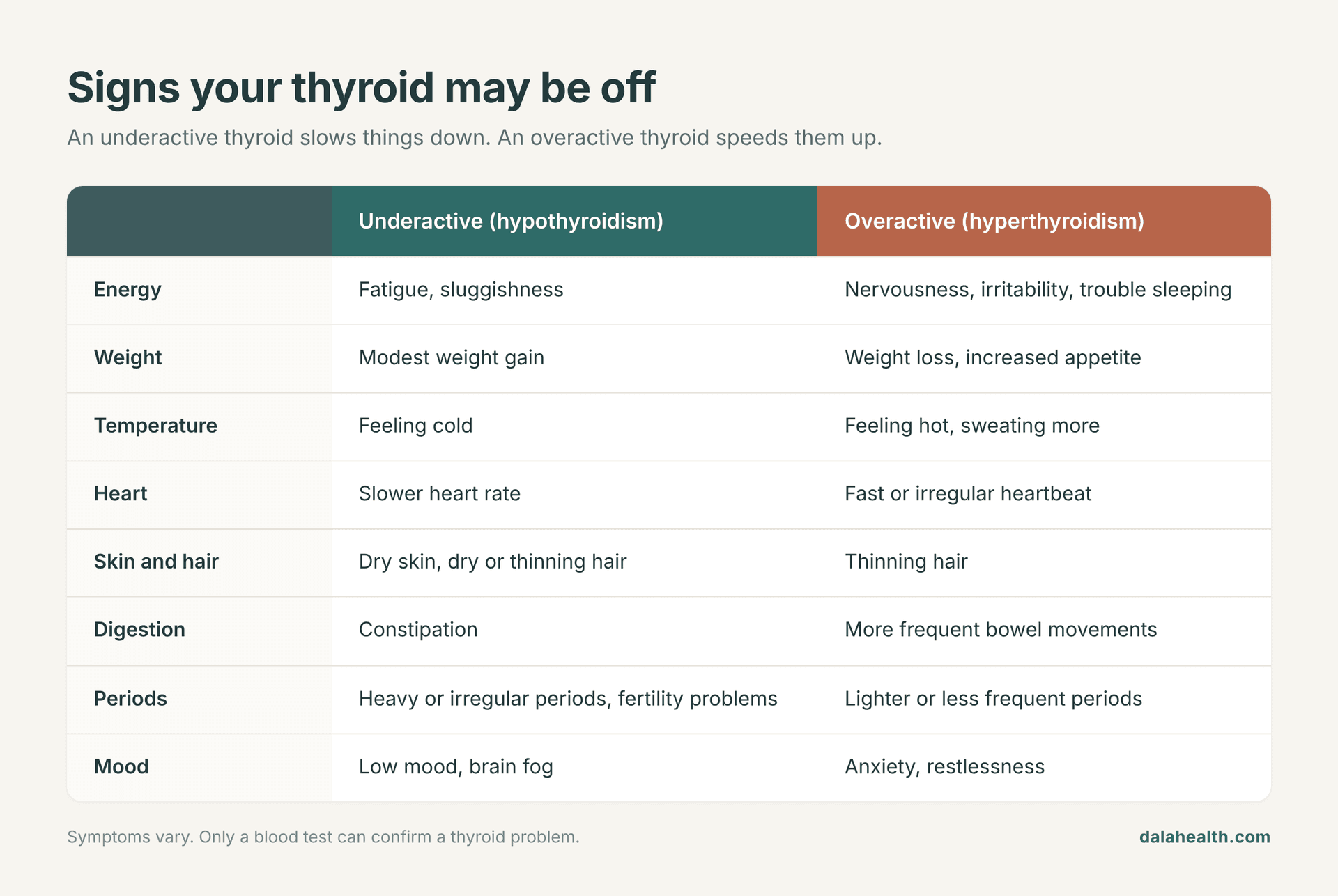
Hypothyroidism tends to develop slowly. Many people don’t notice symptoms for months or even years, and it’s easy to blame them on stress, aging, or menopause. Thyroid nodules (lumps in the gland) are also common, especially after 50, and most are harmless. Still, any new lump or swelling in your neck deserves an exam.
Who is at higher risk
The most common cause of an underactive thyroid in the U.S. is Hashimoto’s disease, an autoimmune condition in which the immune system attacks the thyroid. Your risk is higher if you:
- Are a woman, especially around pregnancy or menopause
- Are over 60
- Have a family history of thyroid disease
- Had a baby or were pregnant in the past six months
- Have had thyroid surgery, radioactive iodine, or radiation to the neck or chest
- Have another autoimmune or related condition, such as type 1 diabetes, celiac disease, rheumatoid arthritis, lupus, or pernicious anemia
- Have type 2 diabetes
- Take certain medications, including some heart, mood-stabilizing, and cancer drugs
If one or more of these applies to you and you have symptoms, that’s a good reason to ask for testing rather than wait it out.
Thyroid and weight: the honest answer
An underactive thyroid can cause weight gain, but usually less than people expect. Much of it comes from your body holding onto extra salt and water, not fat. Estimates commonly put thyroid-related gain at around 5 to 10 pounds, and more when hypothyroidism is severe or goes untreated for a long time.
That has two practical consequences:
- Treatment helps, but it isn’t a weight-loss plan. Once hormone levels are back in range, many people lose some of that weight and feel more energetic. Most don’t lose a large amount from thyroid treatment alone.
- A normal thyroid doesn’t mean you’re imagining it. If your labs are normal and you’re still struggling with your weight, something else is driving it, such as insulin resistance, sleep, stress, medications, or hormonal changes. Those deserve a real plan too.
At DalaHealth, we look at the thyroid as one piece of your metabolic health, alongside blood sugar, cholesterol, blood pressure, and the habits that shape them.
How thyroid problems are diagnosed
Symptoms alone can’t diagnose a thyroid condition. A simple blood draw can. The tests you’re most likely to see:
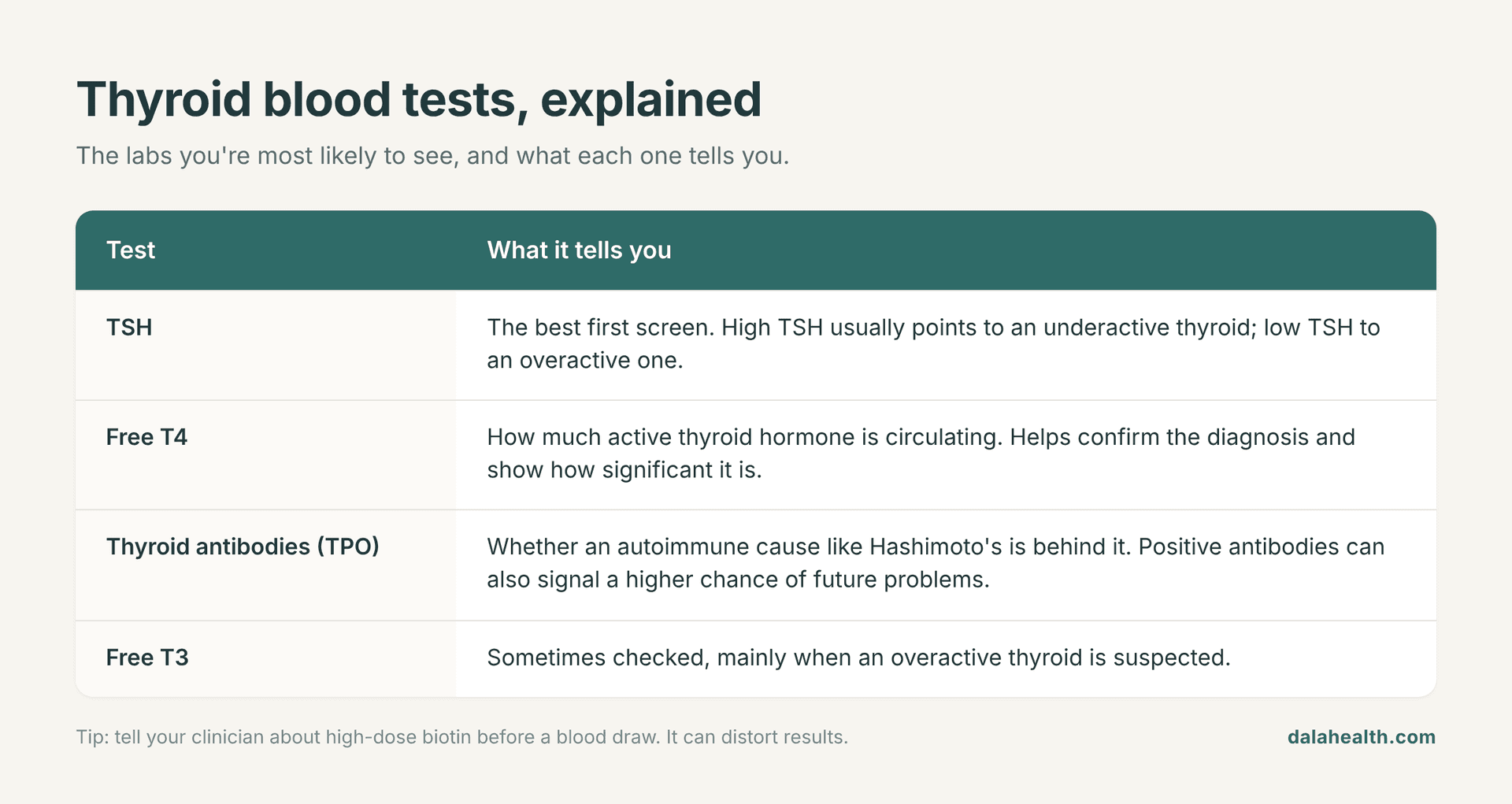
Some people have a mildly high TSH with a normal free T4. This is called subclinical hypothyroidism. It doesn’t always need medication. The right choice depends on your numbers, your symptoms, your antibodies, and whether you’re pregnant or planning to be.
Before your blood draw: tell your clinician about any supplements you take. High-dose biotin, common in hair, skin, and nail products, can distort some thyroid lab results.
Supporting your thyroid day to day
There’s no special “thyroid diet” that fixes a thyroid condition. These habits do make a real difference:
- Skip the iodine megadoses. Your thyroid needs iodine, but most Americans get enough from a normal diet. Large amounts from kelp, seaweed supplements, or iodine drops can actually worsen hypothyroidism, especially with Hashimoto’s.
- Be skeptical of “thyroid support” supplements. Some contain iodine or even thyroid hormone, and they can throw off your labs or your treatment. Check with your clinician first.
- If you take levothyroxine, be consistent. Take it the same way every day, usually in the morning on an empty stomach. Keep calcium, iron, and antacids a few hours away, since they can block absorption.
- Keep up with follow-up labs. After starting or changing a dose, a recheck typically comes 6 to 8 weeks later. Once you’re stable, testing usually drops to about every 6 to 12 months.
- Don’t stop or adjust medication on your own. Too much thyroid hormone carries its own risks, including an irregular heartbeat and bone loss.
- Plan ahead for pregnancy. Many women need a higher dose during pregnancy. If you’re on thyroid medication and become pregnant, contact your clinician promptly.
- Cover the fundamentals. Balanced meals, regular movement, good sleep, and stress management support your metabolism no matter what your thyroid is doing.
A note on GLP-1 weight-loss medications and your thyroid
If you’ve looked into medications like semaglutide (Wegovy, Ozempic) or tirzepatide (Zepbound, Mounjaro), you may have seen a boxed warning about thyroid tumors. Here’s what it means, plainly.
The warning is based on studies in rats and mice, which developed thyroid C-cell tumors on these drugs. The labels state that it is unknown whether this happens in people. Rodent thyroids have far more GLP-1 receptors than human thyroids, and large human studies so far have not shown a clear increase in thyroid cancer.
The warning concerns one rare type, medullary thyroid carcinoma (MTC), which makes up only a few percent of thyroid cancers. These medications are not recommended if you or a family member has had MTC, or if you have a genetic condition called MEN 2.
Having hypothyroidism or Hashimoto’s does not, by itself, rule you out. It’s one more reason a careful history matters before starting any weight-loss medication.
When to get checked
Talk with a clinician about thyroid testing if:
- You’ve had several of the symptoms above for weeks or months
- You have a risk factor, such as a family history or a recent pregnancy
- You notice a lump or swelling in your neck
- You’re already on thyroid medication and still don’t feel right
- You’re considering a weight-loss medication and want a full metabolic picture first
Seek care right away for a racing or pounding heartbeat with chest pain, shortness of breath, or fainting.
Clear answers, one clinician
At DalaHealth, thyroid care is part of how we look at your metabolic health as a whole. Maggie Smith, MSN, FNP-C, will review your symptoms and history, order the right labs, explain your results in plain language, and build a plan with you. That plan might include treatment, nutrition and lifestyle changes, or medical weight loss when it’s appropriate.
Visits are available in person in Westminster or by telehealth across Colorado, and your first consultation is free. Book your free consultation to get started.
This article is for general education and isn’t a substitute for personal medical advice.
References
- Hypothyroidism (Underactive Thyroid), National Institute of Diabetes and Digestive and Kidney Diseases
- Thyroid disorders are more common than you’d think, HealthyWomen, citing the American Thyroid Association
- Can hypothyroidism cause weight gain?, GoodRx Health
- Thyroid and weight gain: what’s normal?, CommonSpirit Health
- GLP-1s and thyroid cancer, Clayman Thyroid Center
- Ozempic and thyroid cancer, Roswell Park Comprehensive Cancer Center